

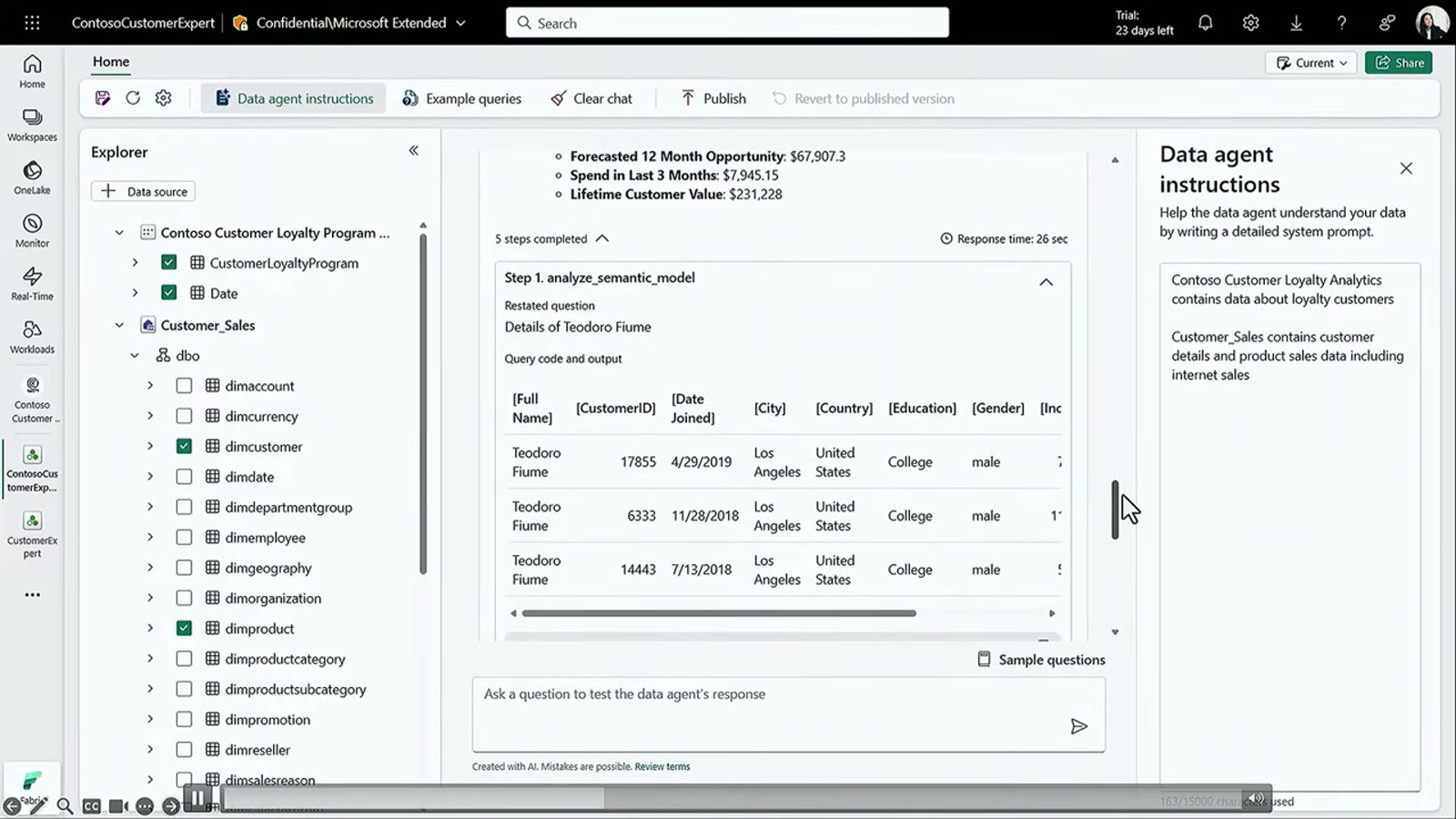
TL;DR
I’m a product designer on Microsoft Fabric Data Agent — a conversational AI that turns plain-English questions into structured answers over enterprise data (SQL, DAX, KQL). The product reached general availability in March 2026, shipped ahead of Microsoft FabCon Atlanta. I own the design for tool management, AI reasoning transparency, and several cross-product features within the broader Fabric and Copilot ecosystem.
What is Data Agent?
Data Agent is an AI-powered item in Microsoft Fabric that lets organizations build conversational Q&A systems over their data. Creators connect data sources — warehouses, lakehouses, semantic models — and configure the agent with instructions and examples. Consumers then ask natural-language questions and get structured, human-readable answers without writing SQL.
It’s part of the broader Microsoft Copilot ecosystem, bringing AI-assisted data exploration to the Fabric analytics platform.
What I design
I own end-to-end design for several core product areas:
-
Tool Management — The framework for extending Data Agent with external tools (MCP servers, Azure AI Search, Fabric functions). I designed the setup flows, configuration patterns, and error states for adding and managing tools.
-
AI Reasoning Transparency — How the agent shows its work. I audited reasoning patterns across 7 tool types, created a reusable 3-category information architecture, and designed a template system that was adopted across all Data Agent projects and referenced by other product teams.
-
Design Library Management — I maintain the Data Agent component library across three design systems (Fluent, Fabric, and Copilot), which doubled prototyping speed for the team. I also onboard new designers to the library ecosystem and mentor them to spec-ready independence.
-
UX Funnel Metrics — I own UX funnel metrics for Data Agent, using product telemetry to identify drop-off points and inform design priorities. This includes tracking engagement patterns across the creator and consumer journeys.
Shaping the AI design process
Beyond product work, I contribute to how the team designs for AI:
-
AI-powered prototyping — Piloted Figma Make as an early adopter and integrated it into the design workflow for usability testing. The higher-fidelity prototypes yielded more actionable customer feedback and influenced peer designers to adopt the tool.
-
Design-to-code component architecture — Led the Fluent bar chart component with a “ready-to-insert instances” philosophy instead of boolean-toggle variants, making components easier for AI-powered design tools and vibe-coding workflows to parse and generate code from.
-
Vibe-coded design prototypes — Built functional running prototypes for complex features like schema object editing, enabling concrete micro-interaction estimation with engineering. This shifted the design-engineering conversation from abstract specs to working behavior.
Scope note
This is an overview of my role, not a full case study. Much of the design process and decision-making is confidential. I’m happy to discuss specific areas in more detail within NDA boundaries.